

Current, Cover Feature
A Thriving Ecosystem
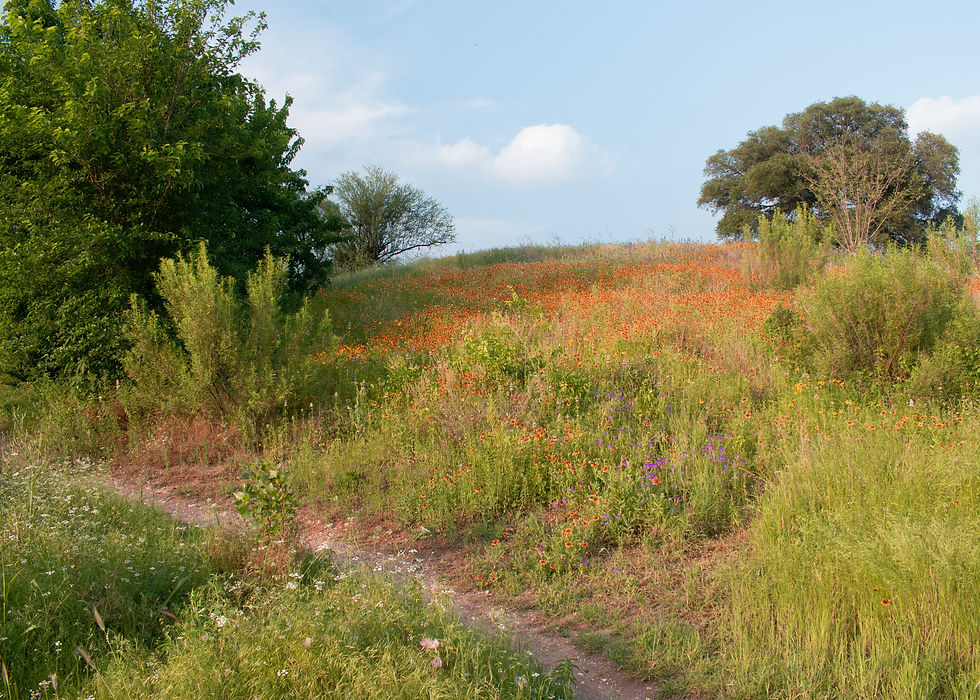
If you live in Mueller, you will likely know Southwest and Southeast Greenways well. Maybe you walk your dog along them in the morning, stop to admire wildflowers in bloom, or pass through on your way to the skate park. But beneath that everyday beauty lies a deeper story shaped by restoration, intention, and a belief that urban life and thriving ecosystems can, and should, coexist. At the center of this vision is RVI Planning + Landscape Architecture, the landscape architect responsible for designing these spaces as both functional infrastructure and meaningful community places.
Like this article? Share it with your friends!
If you live in Mueller, you will likely know Southwest and Southeast Greenways well. Maybe you walk your dog along them in the morning, stop to admire wildflowers in bloom, or pass through on your way to the skate park. But beneath that everyday beauty lies a deeper story shaped by restoration, intention, and a belief that urban life and thriving ecosystems can, and should, coexist. At the center of this vision is RVI Planning + Landscape Architecture, the landscape architect responsible for designing these spaces as both functional infrastructure and meaningful community places.
A Landscape Reclaimed
The Southwest Greenway is one of four major parks surrounding the Mueller development and was once the site of the former Robert Mueller Municipal Airport. When redevelopment began, the land presented both a challenge and an opportunity.
Prior to redevelopment, much of the Southwest Greenway was a paved parking lot. Guided by a bold vision, the team set out to restore the native Blackland Prairie that once covered this region. This ecosystem plays a critical role in water infiltration and in filtering pollutants such as nitrogen dioxide, ozone, and sulfur dioxide. Once stretching from Central Texas to Manitoba, less than 1% of the Blackland Prairie remains today, making its restoration here especially meaningful.
In a remarkable discovery during the redevelopment, soil samples revealed that healthy prairie soil still existed beneath the pavement of the former airport. These soils were carefully stockpiled during construction and reused to support restoration. Native species, including Little Bluestem, were reintroduced to strengthen the prairie’s ecological resilience.
Restoring the Prairie
The Southwest Greenway plays a central role in managing stormwater for the community, but its design tells a much richer story.
At its heart is a pond designed by RVI Planning + Landscape Architecture to feel as though it has always been part of the landscape. Its edges are varied and naturalistic, shaped by mature trees, native boulders, cascading water features, and gently sloping planting shelves.
The pond’s form was carefully influenced by the preservation of an existing grove of mature pecan trees, reinforcing a sense of permanence and continuity. Today, it supports both wildlife and recreation, stocked with fish and frequented by catch-and-release anglers, as well as Great Blue Herons. More than 200 native plant species now thrive throughout the greenway. Beyond their beauty, these grasses and plants contribute to carbon sequestration, making the space not just a park, but a living climate solution.
In 2009, Mueller became the first project in Texas—and the largest in the United States at the time—to achieve LEED for Neighborhood Development certification. The Southwest Greenway played a significant role in that achievement.
An Urban Wetland by Design
A decade later, the Southeast Greenway introduced a new evolution in design, centered around water.
At its core is an urban wetland pond that functions as both stormwater infrastructure and ecological habitat. Also designed by RVI, the pond features softly undulating edges that extend in layered, finger-like forms. These shapes create shallow zones and varied habitats that mimic natural waterways.
This intentional design allows aquatic plants to thrive, improves water quality, and supports a diverse range of wildlife. What could have been a purely utilitarian basin instead becomes an immersive, sensory landscape.
Nearby, the energy of the skate park blends with quieter birding and wetland areas. Shade structures cast dynamic patterns that echo surrounding tree canopies, subtly connecting active and passive spaces. The result is a fluid experience—one that encourages exploration and movement between environments, reinforcing the idea that natural and built systems should feel interconnected.
A Lasting Impact
One of the most meaningful outcomes of the greenways is how it shaped the future of Mueller. The success of prairie restoration demonstrated that native landscapes are not only environmentally beneficial but also viable at a community scale. As a result, landscape design guidelines were updated to require at least 50% of native plantings in new development, with the remainder drawn from well-adapted species.
The greenway also serves as a living classroom. Demonstration gardens help residents learn how to incorporate native plants into their own yards, creating a ripple effect that extends sustainability beyond the park and into everyday life.
Together, Mueller’s greenways and public spaces form something rare: a cohesive system where infrastructure, ecology, recreation, and history are seamlessly intertwined. They demonstrate what’s possible when design goes beyond function—when it is guided by intention, shaped by context, and rooted in a vision for long-term sustainability. And perhaps most importantly, they offer a hopeful reminder: even in the heart of a growing city, nature can thrive and bring us along with it.
Cristina Tangredi is dedicated to creating community-first communications, and has over seven years of experience in nonprofits, government agencies and PR firms.